Here's the thing most people don't realise until they're standing there: Victoria Falls is a completely different experience depending on the month you turn up. The same spot can be a thundering wall of water and spray in April, or a series of quiet cataracts over bare rock in November. Neither is "better" — they're just different trips. The mistake is showing up expecting one and getting the other.
This guide breaks down what the falls actually look like through the year from the Zambia side, when Devil's Pool and rafting are open, and how the weather plays out — so you can pick the months that match the trip you want.
High water (Feb–May) — the falls at full power
Low water (Aug–Jan) — clear views & Devil's Pool
Month-by-month at a glance
A warning specific to the Zambia side
So when should you go?
The Two Seasons That Matter
Forget summer and winter — at Victoria Falls the calendar that matters is the water level of the Zambezi, and it runs on a delay. The rains fall over Zambia and Angola from around November to March, but all that water takes weeks to flood down the river system. So the falls actually peak in March, April and May — well after the rain has stopped — and then steadily drop through the dry months to their lowest point around November, just before the cycle starts again.
That delay is why people get caught out. You can visit in sunny, dry October and find the falls low; you can visit in April under blue skies and find them at maximum flood. The water level is what defines your experience, and it's not the same as the weather.
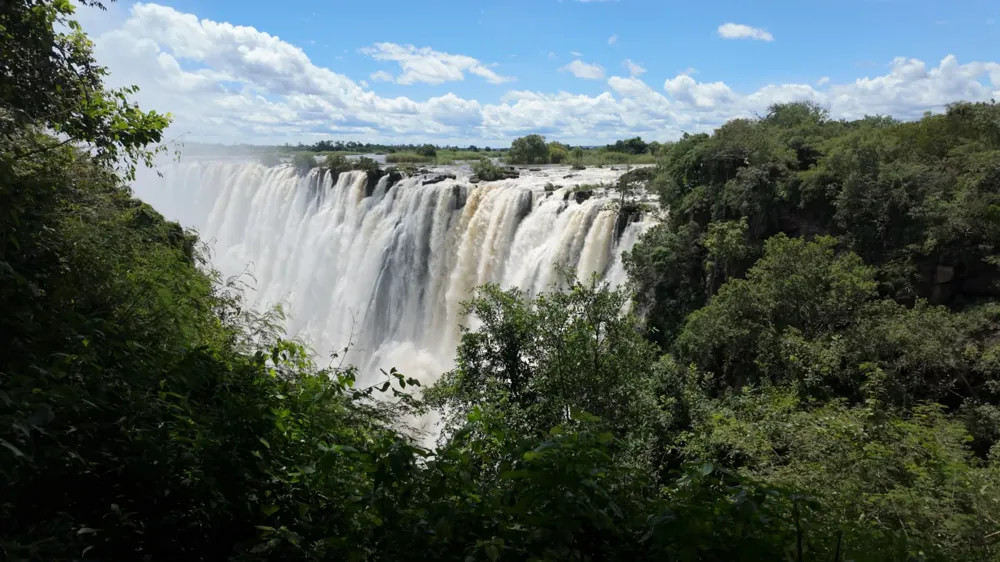
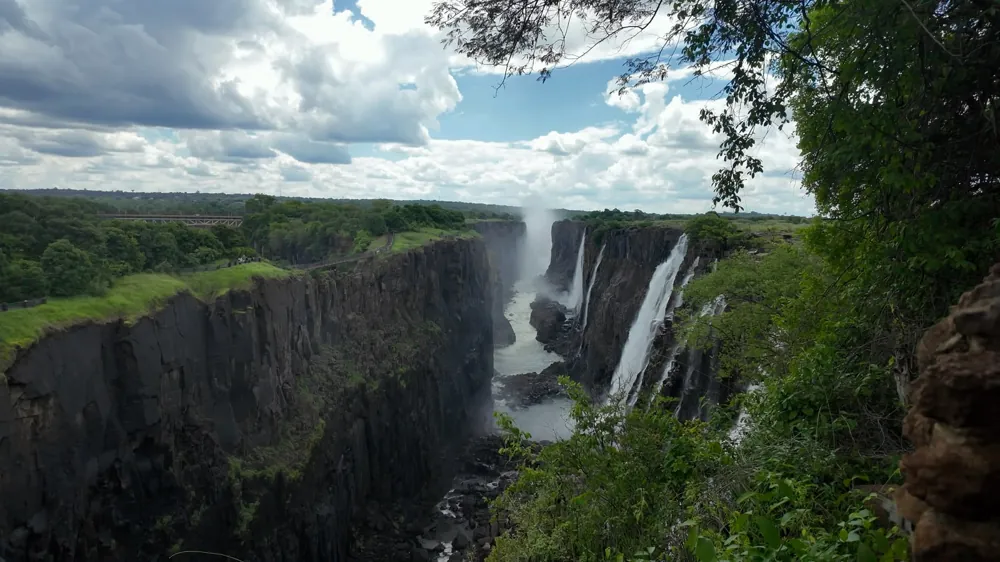
Both photos taken by me in Livingstone — same gorge, different seasons.
High Water (February–May): The Falls at Full Power
This is Victoria Falls as the postcards show it — an unbroken curtain of water more than a kilometre and a half wide, with the spray (the Mosi-oa-Tunya, "the smoke that thunders") rising hundreds of metres into the sky and visible from far outside town. The sound is constant. You will get drenched on the Knife's Edge Bridge, and a raincoat is genuinely pointless — embrace it.
The trade-off: at the absolute peak (around April), there's so much spray that you sometimes can't actually see the falls — you're standing in a warm rainstorm looking at a white wall of mist. It's spectacular in its own way, but if your dream is a crisp photo of the whole curtain, peak flood can frustrate you. This is also when a helicopter flight earns its price, because from above you rise over the spray.
Low Water (August–January): Clear Views & Devil's Pool
As the dry season sets in, the Zambezi drops and the falls thin out into distinct streams falling over the rock face. You lose the overwhelming power — and on the Zambia side, by late in the season, parts of the falls can run nearly dry — but you gain the view: clear sightlines across the whole gorge, no blinding spray, and the chance to actually photograph the structure of the place. The rock face the water has been carving for millennia is suddenly visible.
Crucially, low water is when the adventure activities open up. Devil's Pool — the natural infinity pool right at the lip of the falls — runs roughly mid-August through to mid-January, when the river is low enough to swim safely. White water rafting is at its best from around August to December, when the lower river exposes its full sequence of Grade 4 and 5 rapids.
Visiting in the dry season? Devil's Pool is the one thing you can't do anywhere else on earth — and it sells out fast.
Check Devil's Pool Availability →Month-by-Month at a Glance
January–March: Green season. Warm, humid, afternoon thunderstorms. Falls rising toward full power. Lush landscape, fewer tourists, lower lodge prices. Devil's Pool closes (usually by early-to-mid January).
April–May: Peak water and peak spray. The most dramatic the falls ever get — and the most mist. Pleasant temperatures as the dry season begins. Bring waterproofs for everything you carry.
June–August: The sweet spot for many. Dry, sunny, cooler (mornings can be genuinely cold), still a strong flow of water with good views. Peak tourist season starts. Devil's Pool reopens around mid-August.
September–October: Prime time for Devil's Pool, rafting and wildlife — but also the hottest months, with October regularly climbing past 35°C. Water levels dropping. Book activities and lodges well ahead.
November–December: Lowest water (especially the Zambia side, which can look sparse), but excellent for clear views, swimming and rafting. The first rains arrive, the bush greens up, and prices ease before the holiday peak.
A Warning Specific to the Zambia Side
This is the one thing I'd want a friend to know before booking. At the lowest point of the dry season — roughly late October into November — the Zambian side of the falls can run very low, with stretches of the rock face nearly dry while the bulk of the remaining water flows over the Zimbabwean side. If you're coming specifically in those months and seeing a full curtain of water is your priority, this is worth planning around.
So When Should You Go?
If you want the falls at their most jaw-dropping and don't mind getting soaked: aim for April or May. If you want to swim in Devil's Pool, raft the Zambezi, and get clean photos of the whole gorge: come between September and early December. And if you want the best all-round balance — strong falls, good weather, everything open — June to August is hard to beat, which is exactly why it's the busiest.
Whatever you choose, build your dates around the one thing you most want to do. Decide first whether that's the falls at full flood, the edge swim, or the rapids — then let the calendar follow. Once you know your season, our full activities guide covers what's worth booking.